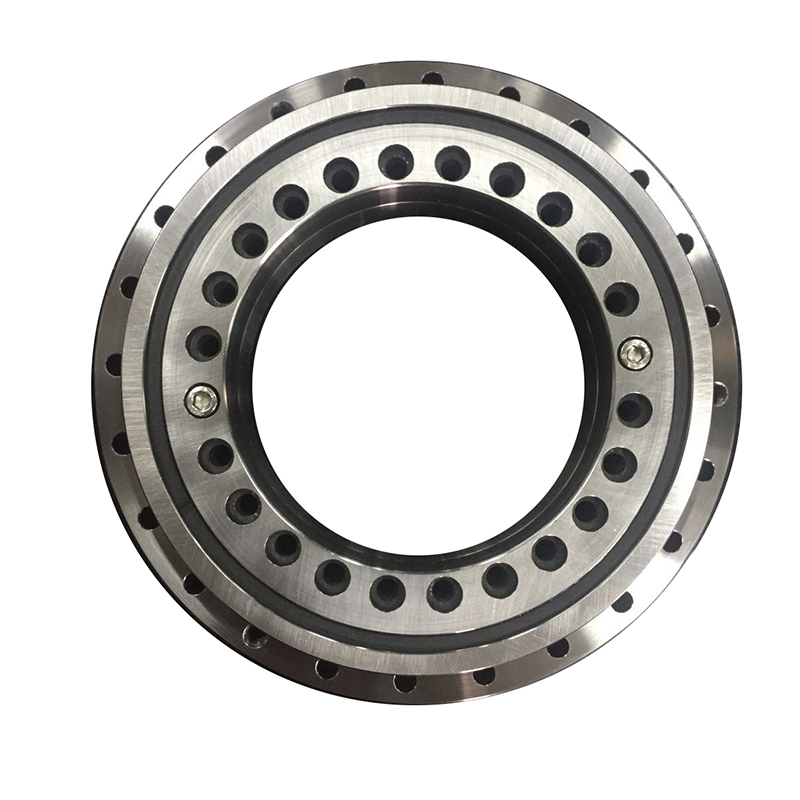
A high-quality small crossed roller bearing’s core characteristic lies in the perfect combination of compactness and precision. It provides rigidity and accuracy far exceeding its size within a minimal space, making it the core “joint” of precision equipment like industrial robots and medical machinery.
Specifically, its features and advantages are as follows:
🎯 High Integration: Multiple Functions in One, Saving Space
This is the most significant feature of small crossed roller bearings. They integrate multiple functions into a single component through a unique design.
-
Technical Support:
-
Orthogonal Roller Arrangement: Cylindrical rollers are arranged at 90° to each other, alternating in a V-shaped raceway. This allows one bearing to simultaneously support radial, axial, and moment loads (complex loads from all directions).
-
Ultimate Compactness: Traditionally, two bearings (like angular contact ball bearings) mounted back-to-back were needed to achieve similar results, taking up significant space. A crossed roller bearing combines both functions, reducing the cross-section area by up to 43% and significantly reducing weight, which is key to equipment miniaturization and lightweighting.
-
-
Advantages: Greatly simplifies equipment structure, eliminates complex support components, and frees up valuable space for precision equipment design.
⚙️ Ultra-High Rigidity and Precision: Small Size, High Capacity
Despite its small size, a high-quality crossed roller bearing excels in rigidity and precision, far surpassing ordinary bearings.
-
Technical Support:
-
Line Contact Loading: Cylindrical rollers create “line contact” with the raceways. Compared to the “point contact” of ball bearings, the load-carrying area is larger, increasing rigidity by 3-4 times.
-
Negative Clearance/Preload Design: High-quality products typically use a “negative clearance” design, meaning the bearing is in a slightly preloaded state from the factory, eliminating internal gaps. This prevents deformation under load after installation, ensuring extremely high rotational accuracy.
-
Split Inner/Outer Rings: The inner or outer ring of the bearing uses a split design, facilitating precise adjustment of the gap. Even with preload applied, highly accurate rotational motion is achieved without seizing.
-
High Precision Grades: High-quality crossed roller bearings can achieve precision grades up to P5, P4, or even P2 (precision from low to high: P0, P6, P5, P4, P2), meeting the demands of top-tier equipment.
-
-
Advantages: Equipment operates more stably without wobble, providing precise “point-to-point” positioning accuracy. It also supports heavier loads and extends equipment life.
🦾 Smooth and Stable Rotation: Low Friction, Long Life
High-quality products ensure smooth operation and durability while pursuing high performance.
-
Technical Support:
-
Spacers/Retainers: Precision-machined spacers or retainers between rollers prevent them from rubbing against each other or skewing, effectively avoiding increased rotational torque.
-
High-Quality Materials and Heat Treatment: Utilizes high-purity bearing steel (e.g., case-hardening steel) and advanced heat treatment processes, ensuring the raceways and rolling elements have very high hardness, wear resistance, and good impact resistance.
-
-
Advantages: Smooth rotation, stable and low starting torque, low operating noise. Less prone to early wear or fatigue spalling, resulting in long service life and high reliability.
Comparison of Features by Different Structural Types
The “Small Crossed Roller Bearing” is a large family. Different types have different structural emphases to suit various installation needs. The table below compares common types:
| Structural Type | Structural Features | Main Advantages | Typical Applications |
|---|---|---|---|
| Basic Type (RB / XRB) | Split outer ring, one-piece inner ring | Classic structure, high rigidity. Suitable when inner ring rotational accuracy is critical. | CNC machine tool tables, industrial robot joints |
| RE Type (RE / XRE) | Split inner ring, one-piece outer ring | Suitable when outer ring rotational accuracy is critical. Flexible installation. | Small precision tables, medical equipment scanner gantries |
| RU Type (RU / XRU) | One-piece inner and outer rings with mounting holes | Easiest installation. No need for additional flanges or support housings, less affected by installation errors. | Collaborative robots, small rotary tables |
| High Rigidity Type (RBH / CRBHV) | One-piece inner and outer rings, no split faces | Highest rigidity and precision. Less prone to installation errors, suitable for high-speed rotation. | Machine tool spindles, high-precision measuring equipment |
| Ultra-Thin Type (CRBT) | Extremely thin cross-section height (down to 5.5mm) | Most compact and lightweight, maximizes space savings. | Semiconductor manufacturing equipment, small medical instruments |
When selecting, if your primary goal is extreme space saving and light weight, focus on the Ultra-Thin Type (CRBT). If maximum rigidity and precision are required and you have good installation capabilities, the High Rigidity Type (RBH/CRBHV) is the best choice. If easiest installation and maintenance is your priority, the RU Type (XRU) with mounting holes is very convenient.