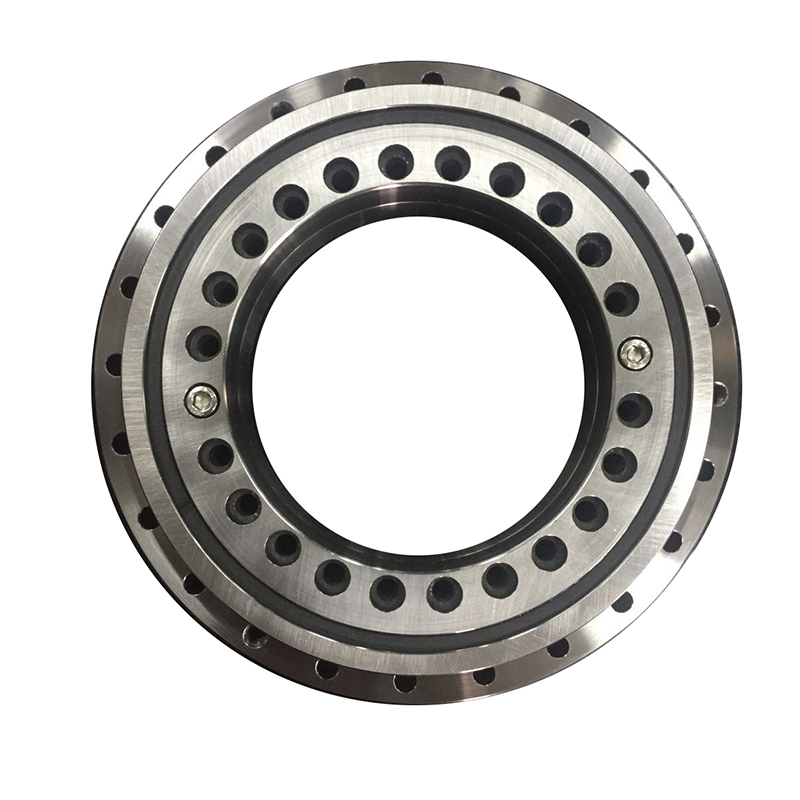
Crossed roller bearings are exemplars of precision engineering. Their design enables them to simultaneously handle complex loads—including radial, axial, and moment loads—while offering high rigidity and rotational accuracy. Their unique structure, with cylindrical rollers arranged crosswise between the inner and outer rings, makes them indispensable in high-precision applications such as robotics, machine tools, and medical equipment. Achieving this level of performance requires meticulous and advanced manufacturing processes.
The journey of a crossed roller bearing from raw material to high-precision component involves several key stages. In terms of model numbers, commonly used series include RA, RB, RE, CRBS, etc. For example:
-
RB1008: A small model with 10mm bore, 18mm outer diameter.
-
RB13010: 13mm bore, 23mm outer diameter.
-
RB25015: 25mm bore, 40mm outer diameter, a very versatile model.
-
RB50025: 50mm bore, 80mm outer diameter.
-
CRB 10UUR: Universal type, 10mm bore.
-
CRB 20UU: Universal type, 20mm bore.
-
CRBF 30UU: Flange mounted type, 30mm bore.
1. Material Selection: The Foundation of Performance
The process begins with the selection of high-grade materials. The most common choice is high-carbon chromium bearing steel, renowned for its high hardness, excellent wear resistance, and good fatigue life. For corrosive environments or non-magnetic applications, other materials like 50Mn steel or stainless steel (e.g., AISI 440C) may be used based on customer requirements, and even ceramic hybrid materials are options.
2. Forging and Forming: Shaping the Blank
The selected steel is cut, heated, and then forged into a rough shape approximating the final bearing ring. This forging process refines the metal’s grain structure, enhancing the material’s strength and durability. Modern cold forging techniques are often employed to improve material utilization and mechanical properties.
3. Turning: Machining to Near-Final Dimensions
The forged rings are then precision-turned on CNC lathes. This step machines the rings to a near-net shape, creating the raceways (the grooves where the rollers run), side faces, and mounting holes to extremely tight tolerances. The accuracy achieved here is crucial for the subsequent grinding and finishing stages.
4. Heat Treatment: The Core of Strength and Durability
This is arguably the most critical stage. The rings and rollers undergo a rigorous heat treatment process, typically including:
-
Hardening: Components are heated to a high temperature and then rapidly cooled. This process significantly increases their surface hardness, making them resistant to wear and indentation.
-
Tempering: After hardening, components are reheated to a lower temperature to relieve internal stresses. This step reduces brittleness and enhances toughness, ensuring the bearing can withstand impact loads without cracking. The result is a component with a hard, wear-resistant surface and a tough, durable core.
5. Grinding: The Pursuit of Micron-Level Precision
After heat treatment, the hardened rings undergo grinding to achieve ultra-fine dimensional and geometric accuracy. This involves several specialized grinding operations:
-
Cylindrical Grinding: For the outer diameter of the outer ring and the inner diameter of the inner ring.
-
Face Grinding: To ensure perfect parallelism and perpendicularity of the side faces.
-
Raceway Grinding: The most critical step. The raceways are ground using ultra-precision machines to achieve a mirror-like finish and profile accuracy within microns. This directly determines the bearing’s smoothness, noise level, and final accuracy.
6. Roller Manufacturing: Crafting the Rolling Elements
Roller manufacturing is a parallel process. High-precision wire is cut to length and then ground and honed into perfect cylinders with strict diameter and roundness tolerances. The ends of the rollers are often finished with a slight crown (relieved ends) to prevent edge stress concentration during operation.
7. Assembly: Integration into a Single Unit
Assembly is a delicate operation, often performed in a cleanroom environment. Due to the crosswise arrangement of the rollers, assembly is more complex than for standard bearings.
-
One ring (often the inner or outer ring, which is split into two halves) is placed in a fixture.
-
Rollers are carefully inserted one by one into the pockets of the retainer, which keeps them evenly spaced and prevents contact and friction between adjacent rollers.
-
The second ring is then carefully fitted to complete the assembly.
8. Cleaning, Lubrication, and Inspection: The Final Check
-
Cleaning: The assembled bearing is thoroughly cleaned to remove any abrasive particles or contaminants from the manufacturing process.
-
Lubrication: It is then filled with specified high-quality grease, or prepared for oil lubrication, selected based on the bearing’s operating speed and temperature range.
-
Inspection: Finally, the bearing undergoes a series of strict 100% full inspections. This includes checks for:
-
Rotational Accuracy: Measuring runout and non-repetitive runout.
-
Preload Torque: Ensuring starting and running torque meet specifications.
-
Noise and Vibration: Testing for smooth and quiet operation.
-
Dimensional Verification: Confirming all critical dimensions are within tolerance.
-
Advanced Technologies in Modern Production
Leading manufacturers are increasingly integrating advanced technologies, such as:
-
Automated Optical Inspection (AOI): For real-time, non-contact measurement of critical features.
-
Superfinishing: A micro-finishing process that further polishes the raceway to a nano-level surface finish, significantly reducing friction and noise.
-
Advanced Simulation: Using Finite Element Analysis (FEA) to optimize raceway profiles and preload for specific application needs.
The production of crossed roller bearings at Luoyang MC Bearing is a process that intertwines advanced machinery, metallurgical science, and rigorous quality control. From forging to final inspection, every step is meticulously controlled to transform raw steel into components that define precision and reliability. As the demand for higher accuracy and performance grows in fields like automation and aerospace, the manufacturing processes for these exceptional bearings will continue to evolve.